Best Etsy SEO Tools in 2026: How to Find Keywords, Optimize Listings & Grow Your Etsy Shop
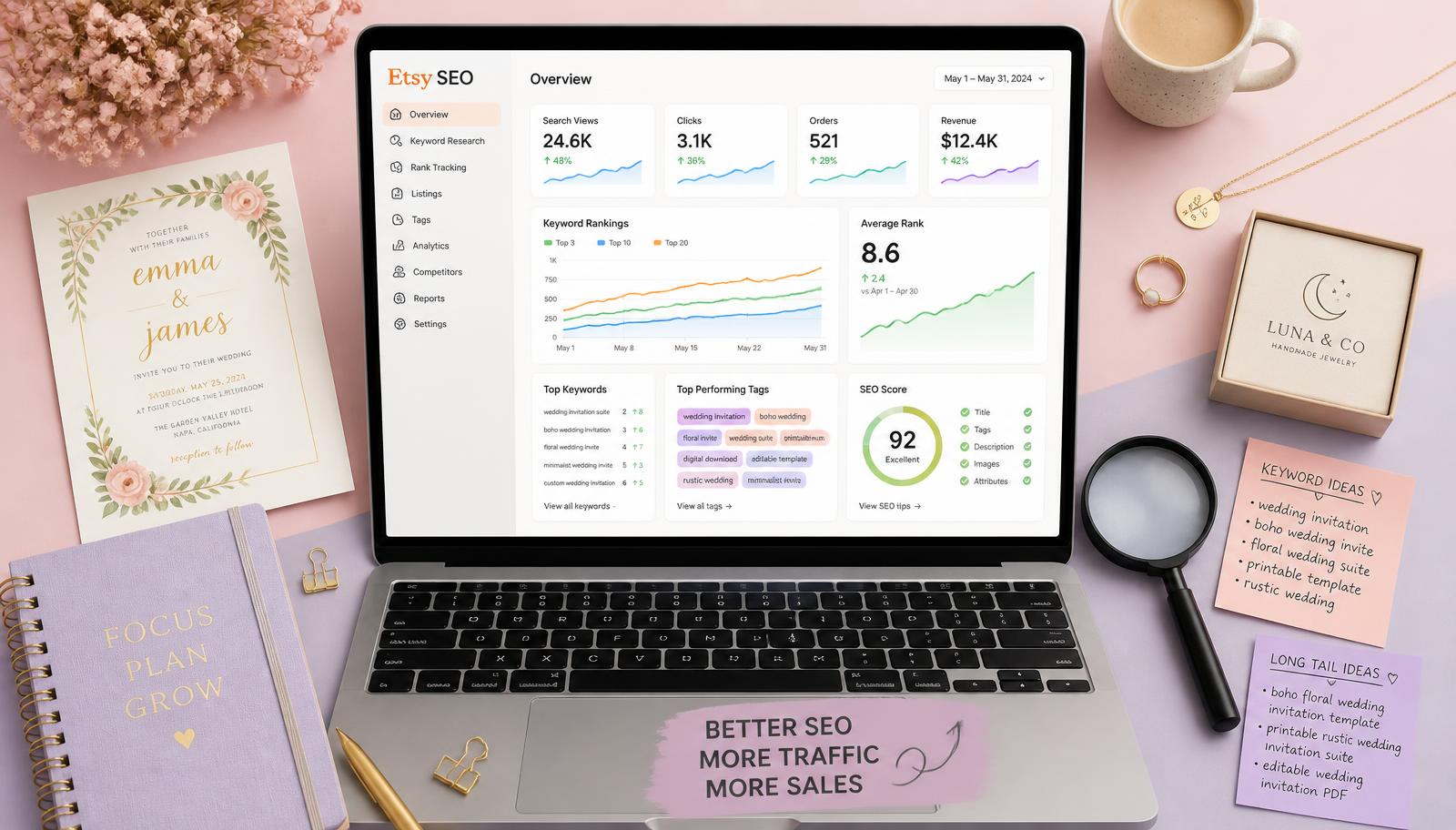
Running an Etsy shop is not only about creating great products. You also need to make sure the right shoppers can actually find those products. With thousands of sellers competing for attention, relying on product quality alone is rarely enough. This is where Etsy SEO becomes important. Etsy SEO helps sellers improve the visibility of their listings by using relevant keywords, clear titles, useful tags, accurate categories, strong descriptions and compelling product images. But doing all of this manually can take a significant amount of time, especially when you have dozens or hundreds of listings. That is why many Etsy sellers are turning to Etsy SEO tools and AI-powered software to speed up keyword research, listing optimization and competitor research. In this guide, we'll explain what Etsy SEO tools do, how to choose the right keywords, how to optimize an Etsy listing and how an all-in-one platform such as CraftGlowAI can simplify the process.
What is Etsy SEO?
Etsy SEO is the process of optimizing your Etsy shop and product listings so they have a better chance of appearing when shoppers search for relevant products. When someone searches for something like 'personalized wedding gift' or 'digital wedding planner,' Etsy needs to determine which listings are relevant to that search. Your listing information helps Etsy understand what your product is and which searches it may match.
This means your Etsy title, tags, categories, attributes and description all matter. However, SEO is not simply about adding as many keywords as possible. A successful strategy starts with understanding what your potential customer actually wants and how they describe that product when searching.
Why Etsy SEO matters in 2026
Etsy has become highly competitive across popular categories such as jewelry, digital products, wedding items, home decor, clothing and personalized gifts. A broad keyword such as 'jewelry' may have significant demand, but it can also be extremely competitive. A more specific phrase such as 'minimalist silver hoop earrings' communicates much stronger buying intent.
This is why modern Etsy SEO should focus on relevance, search intent and realistic opportunities, rather than simply chasing the keyword with the largest possible search volume. Recent Etsy SEO guidance also emphasizes that there is no guaranteed formula for reaching the top of search results. SEO can improve your visibility, but rankings depend on multiple factors and shopper behavior. For sellers, the practical goal is simple: get your products in front of relevant shoppers and give those shoppers a reason to click and buy.
What is an Etsy SEO tool?
An Etsy SEO tool is software designed to help sellers research, analyze and improve their Etsy listings. Depending on the platform, an Etsy SEO tool may help with keyword research, search-term discovery, competition analysis, Etsy title optimization, Etsy tag research, listing descriptions, listing audits, product research, trend research, shop analytics and AI-generated listing content.
The biggest advantage is efficiency. Instead of spending hours manually researching competitors and creating keyword lists, sellers can use specialized tools to organize the information and make faster decisions.
How to choose the right Etsy SEO tool
Not every Etsy SEO tool is designed for the same type of seller. Before choosing one, consider what you actually need. A good tool should support the three pillars below: keyword research, competition analysis and listing optimization.
1. Keyword research
Keyword research should be one of the most important features. A good tool should help you discover relevant phrases instead of simply giving you a huge list of random keywords. For example, if you sell an editable wedding invitation, your keyword research might include: editable wedding invitation, digital wedding invitation, Canva wedding invitation, printable wedding invite and bridal invitation template. The best keyword depends on your exact product and target customer.
You can also use the CraftGlowAI Etsy Keyword Research Tool to research keyword opportunities and organize your ideas around buyer intent.
2. Competition analysis
Finding a keyword is only the beginning. You also need to understand how difficult it may be to compete for that keyword. Competitor research can help you identify common keyword themes, product positioning, pricing patterns, listing quality, popular product features and potential content gaps. Instead of copying successful sellers, use competitor research to understand what the market is doing and identify opportunities they may have missed.
CraftGlowAI's Etsy Competitor Analysis is designed to help sellers investigate competing listings and understand how they are positioned.
3. Listing optimization
Keyword research becomes much more useful when you can immediately apply it to your listing. A strong Etsy listing should communicate the product clearly while incorporating relevant search terms naturally. Your optimization process should include the primary keyword, supporting keywords, title, tags, description, categories, attributes and product images.
The objective is not to create a title that looks like a collection of keywords. The objective is to create a title that both Etsy can understand and shoppers can easily read.
How to find better Etsy keywords
One of the biggest mistakes new Etsy sellers make is choosing keywords based only on what they think people search. Instead, start with your actual product and follow the four steps below.
Step 1: Identify your seed keyword
Write down the simplest description of your product. For example, if your product is a Digital Wedding Planner, possible seed keywords could include: wedding planner, digital planner, wedding planning template, bridal planner and wedding checklist. These are starting points rather than final keywords.
Step 2: Think like your customer
Imagine you are the person who wants to purchase your product. What would you type into Etsy? Someone searching for a digital wedding planner may search for 'editable digital wedding planner' rather than simply 'planner'. The more specific search phrase can communicate stronger buying intent. This is why keyword research should begin with buyer language, not seller terminology.
Step 3: Explore long-tail keywords
Long-tail keywords are more specific search phrases containing multiple words. Examples include printable wedding planner, minimalist wedding invitation, personalized baby gift, digital budget planner and beginner crochet pattern. Long-tail keywords can be valuable because they often describe a more specific customer need. However, you should not automatically assume that every long-tail keyword has low competition. Always validate the opportunity before targeting it.
Step 4: Compare demand and competition
A keyword with high demand is not automatically the best keyword. Imagine you discover two phrases: Keyword A has very high demand but extremely high competition, while Keyword B has moderate demand, manageable competition and strong relevance. Keyword B may be the more realistic opportunity for a growing shop. The ideal keyword balances demand, competition, relevance, search intent and product fit. This approach is more sustainable than simply targeting the biggest keyword available.
How to optimize an Etsy listing
Once you've completed your keyword research, the next step is turning those keywords into a useful listing. Focus on three areas: a clear title, strategic tags and a helpful description.
Write a clear Etsy title
Your title should immediately explain what you're selling. For example, instead of writing 'Beautiful Product Best Gift Amazing Handmade Item,' you could create something much clearer: 'Editable Digital Wedding Planner Template for Brides.' The second version gives the shopper an immediate understanding of the product. Avoid turning your title into a repetitive keyword list. SEO should support readability, not make your listing difficult to understand.
Use your Etsy tags strategically
Etsy currently allows up to 13 tags per listing, with each tag limited to 20 characters. Don't waste these spaces by repeating essentially the same phrase. Instead, use relevant variations that describe different aspects of your product. For a wedding planner, relevant concepts might include wedding planner, bridal planner, wedding checklist, digital planner and wedding template. Only use tags that genuinely describe your product.
Improve your description
Your description should help both search engines and shoppers understand your product. Start with a clear opening sentence, for example: 'This editable digital wedding planner helps brides organize their wedding timeline, budget, checklist and important planning details.' Then explain what the buyer receives, the file format, product dimensions, editing instructions, how delivery works, what software is required, important limitations and frequently asked questions. Don't repeatedly insert the same keyword into every sentence. Natural language is better for both shoppers and your overall content quality.
Why Etsy listing optimization is more than keywords
A common misconception is that Etsy SEO is only about keywords. Keywords help Etsy understand your product, but shoppers still need to click and purchase. Your listing should therefore work as a complete package. Think about the journey: search visibility, click, product page, purchase. If your listing receives impressions but very few clicks, your main image, title, pricing or overall presentation may need improvement. If shoppers click but don't purchase, the problem may be your product presentation, description, price, reviews, shipping information or the product itself. This is why SEO should be combined with conversion optimization.
Use AI to speed up Etsy SEO
AI can make repetitive Etsy tasks considerably faster. Instead of starting every listing from a blank page, sellers can use AI to generate ideas and then review and personalize the results. For example, an AI Etsy listing generator can help create SEO-focused titles, Etsy tags, product descriptions, listing ideas and social media captions. CraftGlowAI's AI Etsy Listing Generator allows sellers to turn a product idea into a complete Etsy listing workflow. The important point is that AI should be treated as an assistant, not a replacement for seller judgment. Always check that the generated content accurately describes your product.
Why an all-in-one Etsy SEO tool can save time
Many Etsy sellers use separate tools for different tasks. One tool may handle keywords. Another may handle competitors. Another may generate listing content. Another may create mockups. Another may track trends. Managing several platforms can quickly become expensive and complicated. An all-in-one Etsy SEO platform brings multiple parts of the workflow together.
CraftGlowAI combines keyword research, listing generation, competitor analysis, niche research and creative tools in one platform. A practical workflow could look like this: find a product idea, research keywords, check competitors, identify an opportunity, create and optimize the listing, publish, monitor performance, then update based on data. This is much more organized than randomly changing Etsy tags every few days.
Etsy SEO tools vs manual research
Manual research can still be useful. In fact, every seller should understand the basics of Etsy search. You can begin by searching Etsy manually, studying autocomplete suggestions, reviewing competing listings, looking at product categories and studying customer language. The problem is that manual research becomes difficult at scale. If you have 100 listings, researching every product manually can consume a huge amount of time. That's where an Etsy SEO tool becomes especially valuable. The tool handles repetitive research while you focus on decisions that require human judgment.
Common Etsy SEO mistakes to avoid
A few mistakes undermine otherwise good Etsy SEO strategies. Avoid the following to keep your shop on track.
Targeting only high-volume keywords
The biggest keyword isn't always the best opportunity. Look at relevance and competition as well. A high-volume keyword that doesn't match your product will rarely convert.
Using irrelevant keywords
Never target a popular keyword simply because it has high demand. If your product doesn't satisfy the search intent, shoppers are unlikely to convert.
Keyword stuffing
Repeating the same phrase throughout your title and description can make your listing look unnatural. Write for humans first.
Ignoring competitors
Competitor listings can reveal valuable information about product positioning, pricing, keywords and customer expectations.
Changing everything at once
If you change your title, tags, images and pricing simultaneously, it becomes difficult to understand which change actually affected performance. Make thoughtful changes and monitor the results.
How CraftGlowAI fits into an Etsy SEO workflow
CraftGlowAI is designed around the idea that Etsy sellers shouldn't have to use multiple disconnected tools for every part of their SEO workflow. You can begin with Etsy keyword research, identify relevant opportunities, then use competitor analysis to understand the market. After that, you can move into listing creation and optimization using the AI Listing Generator. The platform also provides additional tools for sellers who want to research niches, analyze listings and create marketing assets. This makes it possible to move from research to implementation without constantly switching between different platforms.
Final thoughts
Etsy SEO is no longer about stuffing as many keywords as possible into a listing. The smarter approach is to understand your customer, research relevant search phrases, evaluate competition and create listings that are genuinely useful to shoppers. A strong Etsy SEO workflow looks like this: research, analyze, optimize, publish, monitor, improve. Keyword research helps you discover what shoppers are searching for. Competitor analysis helps you understand the market. Listing optimization helps you turn that research into a listing that is easy to discover and understand.
For sellers who want to simplify the process, CraftGlowAI brings these essential Etsy SEO tasks together in one workflow, helping sellers spend less time jumping between tools and more time building their shops. If you're serious about growing an Etsy shop in 2026, start with better research — not more guesswork.
Frequently asked questions
What is the best Etsy SEO tool?
How do I find low-competition Etsy keywords?
Can an Etsy SEO tool guarantee page-one rankings?
How many Etsy tags can I use?
Is AI useful for Etsy sellers?
Try it inside CraftGlowAI
Every technique in this article is built into the platform.
More Etsy SEO guides
- Etsy Keyword Research 2026: Complete Guide to Finding Better Keywords
- Etsy Tag Character Limit 2026: Complete Guide to Etsy Tags
- The Complete Etsy SEO Checklist for 2026
- How to Rank an Etsy Listing on Page 1 in 2026
- Best Etsy Tags Generator: How to Pick 13 Tags That Actually Rank
- Best Etsy SEO Tool in 2026: The Ultimate Guide to Ranking Higher and Getting More Sales
- Etsy Keyword Research Guide 2026: How to Find Low Competition Keywords That Actually Sell
- How to Write Etsy Titles That Rank and Convert in 2026
- Etsy Product Research 2026: Find Winning Products That Sell
- How to Sell Digital Products on Etsy in 2026: The Complete Beginner-to-Pro Guide
- Etsy Listing Optimization Guide 2026: How to Create Listings That Rank Higher and Convert More Sales
- Etsy SEO for Digital Products in 2026: How to Find Keywords, Optimize Listings & Get More Sales
- Etsy Listing Titles 2026: Complete Guide to Better Etsy SEO
- Etsy SEO 2026: 15 Ways to Rank Higher and Get More Sales